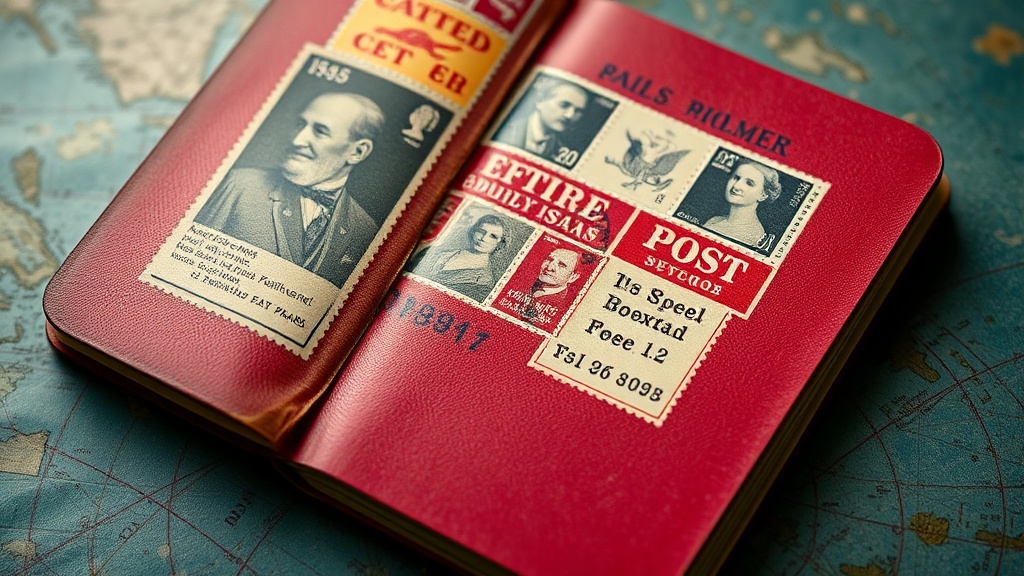
Should You Ever Remove Stamps from Inside a Vintage Passport?

The Collector's Dilemma Nobody Talks About
There's a stubborn myth floating around vintage passport circles—that serious collectors prize blank, unstamped pages above all else. Clean slates. Pristine interiors. The assumption goes that stamps somehow "deface" a document's value, that they're messy reminders of someone else's travels rather than integral pieces of history. This misconception leads newcomers down a destructive path, quietly snipping out stamp-filled pages to "improve" their acquisitions. What this guide covers is why that's almost always a terrible idea—and what you should know about preserving the complete story contained within these fragile documents.
Vintage passports aren't just leather-bound booklets with fancy covers. They're time capsules. Each stamp, each visa, each customs mark represents a specific moment when a real person crossed a border, embarked on an adventure, or fled a difficult situation. Removing those stamps doesn't clean up a passport—it amputates its history. And here's the part that surprises most collectors: in the current market, passports with rich documentary evidence of travel often command higher prices than their blank counterparts. The stamps are the value proposition.
Why Do Some Collectors Consider Removing Stamps in the First Place?
The impulse usually comes from misunderstanding what makes a collectible passport desirable. New collectors—especially those crossing over from stamp collecting—sometimes view vintage passports as premium "albums" for housing interesting postal stamps. They'll spot an unusual 1930s Czechoslovakian entry stamp and think, "That's worth more as a standalone piece." So out comes the razor blade.
Others encounter water-damaged pages where stamps have bled or pages have stuck together, and they assume separation requires sacrifice. (It doesn't—there are techniques for dealing with stuck pages that preserve both sides.) Some collectors simply prefer the aesthetic of blank pages, imagining their passports as unused museum pieces rather than well-traveled documents.
The problem? Once you remove a page from a passport, you've committed an irreversible act. You've transformed a complete artifact into a compromised one. The binding loosens. The pagination sequence breaks. And any future buyer will spot the gap immediately—passport pages are numbered, after all. What seemed like "improvement" becomes permanent damage.
What Information Do Passport Stamps Actually Reveal?
Stamp collectors have long understood that cancellation marks tell stories—dates, locations, postal routes. Passport stamps function similarly but with added layers of biographical and geopolitical significance. A 1958 entry stamp from Bombay might indicate business travel during India's early republic years. A series of rapid-fire European stamps from August 1939 could document a desperate escape route as war loomed.
Beyond the obvious date and location data, stamps encode subtler information. The specific design of a customs entry mark changed frequently—governments updated typography, added security features, adjusted border artwork. These variations help researchers and collectors date documents precisely and track administrative evolution. The Passport Collector community maintains extensive databases correlating stamp designs with specific eras and issuing authorities.
Visa stamps add another dimension entirely. Long-stay visas, work permits, residency authorizations—these indicate not tourism but relocation, employment, perhaps romance or family reunification. A 1960s passport containing a Brazilian permanent residency visa tells a fundamentally different story than one filled with tourist entry stamps. Remove those pages and you've erased the narrative arc.
Are There Ever Legitimate Reasons to Separate Stamps from Passports?
Professional archivists and museum conservators occasionally face situations where separation becomes necessary—but these are extreme cases involving severe mold infestation, chemical contamination, or paper degradation that threatens adjacent materials. Even then, the decision isn't taken lightly. Documentation protocols require photographing the intact passport, recording page numbers, and preserving the physical relationship between stamps even after separation.
For private collectors, legitimate separation scenarios are vanishingly rare. Perhaps you've acquired a passport where previous owners already removed pages, leaving orphaned stamps loose in an envelope. In those cases, you're working with fragments rather than making fragments—different ethical territory entirely. Or you might encounter stamps that were never properly affixed, clinging by a single perforated edge, where attempting reattachment risks tearing.
Here's a useful framework: if the passport is complete and the stamps are physically attached, leave them attached. The National Archives preservation guidelines for travel documents emphasize maintaining original order and physical integrity. Your personal preference for blank pages doesn't override centuries of archival best practice.
How Should You Handle Damaged or Problematic Stamp Pages?
Let's address the practical concerns that drive people toward removal. Stuck pages—the bane of cellulose-based documents in humid climates—can often be separated using controlled humidity chambers or specialized paper conservator techniques. Yes, professional conservation costs money. But weighed against the irreversible loss of historical information, it's usually worth the investment for significant pieces.
Water damage presents trickier challenges. Stamps that have bled or pages that have warped require assessment by someone trained in paper conservation. The American Institute for Conservation maintains a directory of qualified professionals. Many collectors are surprised to learn that even severely water-damaged passport pages can be stabilized without removing contents.
For mold issues—act fast, but don't panic. Isolate the passport from your collection immediately to prevent spore spread. Surface mold on stamps or pages can often be treated through dry cleaning methods or, in serious cases, by conservators using specialized fumigation chambers. Removal isn't the solution; it's surrender.
What About Display and Storage Considerations?
Some collectors worry that stamp-heavy pages create bulk that stresses bindings or makes storage awkward. Fair concern—but the solution isn't amputation. High-quality archival storage accommodates varied page thicknesses without forcing the issue. Polyester film sleeves (the L-sleeve variety, not fully sealed) provide support for stamp-heavy spreads while allowing the passport to rest naturally.
When displaying passport spreads—say, opening to a particularly interesting visa page for exhibition—use cradles or book supports that distribute weight across the binding rather than forcing the book flat. This prevents stress on the gutter where stamps attach. Humidity control matters enormously here; fluctuating moisture levels cause paper expansion and contraction that can loosen adhesive over time.
If you're photographing stamps for insurance documentation or research sharing, use indirect natural lighting and avoid pressing the passport flat against glass or scanner beds. Stamp inks—especially older formulations—can offset onto opposing pages under pressure. Gentle handling preserves both the stamps and the passport that holds them.
Building a Collection Philosophy That Honors Complete Stories
The best vintage passport collectors develop an instinct for wholeness. They recognize that a 1920s League of Nations passport with thirty stamped pages carries more historical weight than a blank version—more research potential, more human narrative, more connections to specific moments in time. This isn't sentimentality; it's sophisticated collecting.
When you acquire a stamped passport, you're accepting stewardship of someone else's documented life. That German engineer's business trips to Argentina. That diplomat's postings across colonial Africa. That refugee's desperate border crossings. These stories don't belong to you in a way that permits editing. They belong to history, entrusted to your care.
The market increasingly recognizes this. Auction results from specialized document sales show consistent premiums for passports with extensive travel documentation versus blank examples. Serious collectors—institutions, researchers, advanced private buyers—prioritize completeness over cosmetic "cleanliness." A passport with stamps is a passport with provenance, with context, with something to say.
So the next time you encounter a vintage passport filled with inked impressions from Cairo, Singapore, or Ellis Island, resist the urge to curate. Don't improve it. Preserve it. The stamps aren't damage—they're data. They're dialogue across decades. And they're exactly what make your collection worth having in the first place.