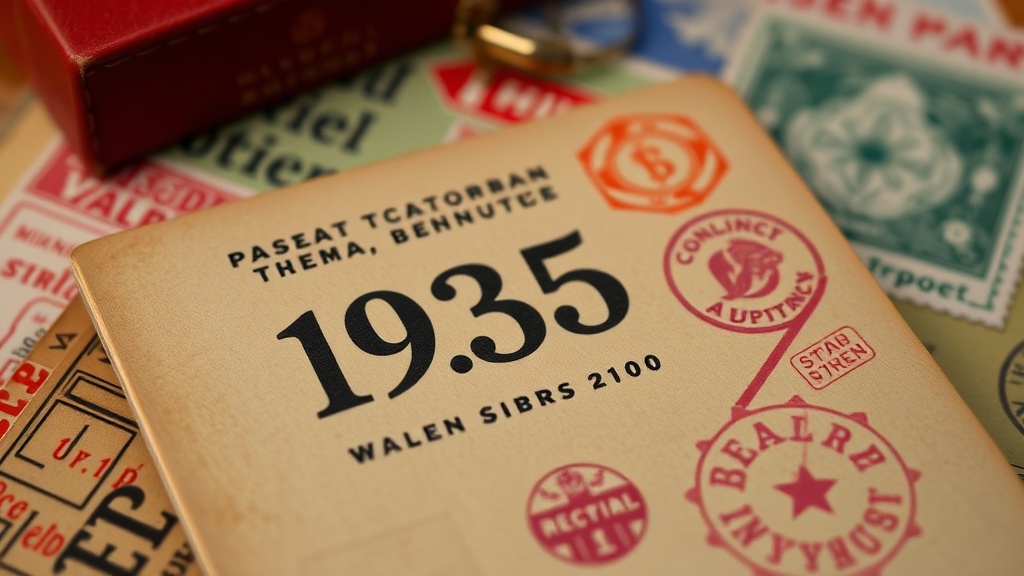
What Do the Numbers and Stamps Inside Your Vintage Passport Actually Mean?

What Do Those Handwritten Numbers in the Corner Actually Mean?
You're at an estate sale in Royal Oak, flipping through a shoebox of paper ephemera, when you spot it—a navy blue passport issued in 1952, corners soft with age, cover stamped with a gold eagle that hasn't quite faded. You open it. Inside, beside the faded photograph of a stern-looking man in a fedora, there's a penciled notation in the upper corner: "47-392." Another stamp reads "P-14." The dealer wants $40. Is this worth it? What do these marks even signify?
Those cryptic numbers aren't random. In vintage passport collecting, marginalia—the handwritten or stamped annotations added by consular officials, border agents, and even the owners themselves—often tells a more interesting story than the passport's design. The "47-392" likely indicates a consular filing number from 1947, possibly referencing a previous passport or a citizenship petition. The "P-14" might denote a specific issuing office—perhaps the 14th district office of the State Department's Passport Division, which operated differently than today's simplified system.
Understanding these markings matters because they authenticate the document's provenance. A passport with clear consular markings from, say, the U.S. Consulate in Marseille circa 1938 carries historical weight—it was issued during a narrow window when refugees fleeing occupied Europe desperately needed travel documents. That context transforms a $30 curiosity into a $300 piece of social history. The numbers aren't just bureaucratic residue; they're coordinates pointing to specific moments when borders opened or closed.
Pre-1950s passports often contain multiple numbering systems operating simultaneously. You might see a volume number (indicating which leather-bound register the application was recorded in), a serial number (unique to the document), and a fee stamp number (tracking payment). Post-1955, the State Department standardized on a single serial system, but earlier pieces—especially those issued by consulates abroad—can display three or four different numeric sequences. Don't dismiss these as clutter. Photograph them, research them, and you'll often discover the specific diplomatic station and even the clerk who processed the application.
Why Do Some Vintage Passports Have Multiple Stamp Pages for a Single Trip?
Collectors sometimes open a 1920s passport and find what looks like overkill—eight or nine pages covered entirely in exit and entry stamps from a single three-month European tour. Was the carrier showing off? Hardly. Before standardized international agreements simplified border crossings, many countries required visas obtained in advance, entry stamps, exit stamps, transit stamps, and sometimes additional police registration stamps for each city visited.
The density of stamps reveals how borders functioned in that era. A 1930s passport moving through Central Europe might accumulate stamps from Czechoslovakia, Austria, Hungary, and Yugoslavia—all countries that, within a decade, would cease to exist or transform radically. Each inked impression captures a geopolitical entity at a specific moment. The National Archives maintains extensive records showing how passport stamp formats changed as diplomatic relationships shifted, particularly during the interwar period when visa requirements fluctuated constantly.
There's also a practical consideration for collectors: heavy stamp density can actually damage vintage passports. The ink used before 1940 often contained iron-based compounds that oxidize over time, creating brownish "ghost" impressions that bleed through to adjacent pages. If you're examining a densely stamped passport, check whether the ink has migrated—that's not necessarily a dealbreaker, but it affects how you should store the document. Interleaving acid-free tissue between stamped pages prevents further transfer, something the Library of Congress preservation guidelines recommend for any document with unstable pigments.
Some of the most sought-after vintage passports feature stamps from defunct nations or unusual diplomatic situations. A passport with entry stamps from the Free City of Danzig (1920-1939) or visas from the Chinese Legation before the Communist revolution carries cachet precisely because those issuing authorities no longer exist. The stamps become primary source documents for historians studying border control evolution. I've seen collectors pay premiums for passports containing transit visas from the Soviet Union during the brief 1958-1959 period when American tourists could visit—those specific stamps represent a diplomatic thaw that lasted only months.
How Can Stamp Placement and Marginal Notes Affect Value?
Here's where opinion enters the room—not all markings enhance value. A passport with extensive personal writing—addresses, phone numbers, packing lists scribbled in the endpapers—typically commands less than a clean specimen. The difference isn't just aesthetic. Personal notations often indicate heavy use, which means the physical object has suffered more flexing, more exposure to moisture and light, more general wear. That said, certain annotations actually increase desirability: occupations listed (especially unusual ones like "wireless operator" or "mineralogist"), emergency contact information for consulates, or addresses that later became historically significant.
The placement of official stamps matters too. Consular officials sometimes stamped directly over the bearer's photograph—a security measure meant to prevent photo substitution. To modern eyes, this looks like vandalism. To collectors, it's authentication gold. A well-placed consular stamp bridging the photo and the page creates a physical seal that's nearly impossible to forge convincingly. The Smithsonian's passport collection includes several examples where these stamped photographs have been forensically analyzed to verify their period authenticity.
Watch for cancellation marks as well. When a passport expired or was replaced, consular clerks often punched holes through the cover, scrawled "CANCELLED" across the data page, or clipped the corners. These weren't random acts of destruction—they were deliberate efforts to prevent reuse by unauthorized parties. For collectors, cancellation style helps date the document's retirement from service. A heavy X drawn in fountain pen suggests a different era than a mechanical perforation pattern. Some cancellation marks even include the date and location of the cancellation office, adding another data point to the object's history.
Pricing vintage passports requires weighing all these factors together. A common 1950s U.S. passport with clean pages might fetch $25-40. The same passport with complete entry/exit stamps documenting a 1957 round-the-world voyage—including rare stops in Ceylon and the Federation of Rhodesia—could sell for $150-200. Add consular markings from a defunct diplomatic post, and you're looking at $300+. The market isn't arbitrary; it reflects how much historical narrative the object contains. Beginning collectors often obsess over condition grades, but in this niche, provenance frequently trumps pristine paper.
When you're evaluating that estate sale find—the one with the penciled "47-392" and the mysterious "P-14"—take time to decode what you're seeing. Photograph every mark, research the consular district codes, and trace the stamp geography. You might discover that stern man in the fedora was a radio correspondent covering the early Cold War, or a merchant marine sailing the last days of British colonial ports. The numbers aren't noise. They're the compressed record of a life lived across borders, waiting for someone patient enough to read them.