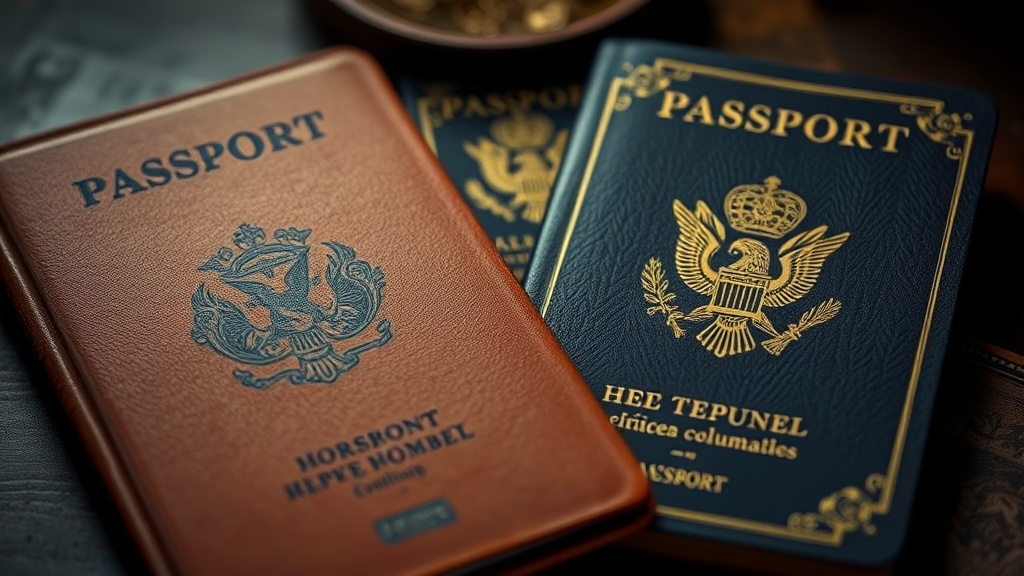
Forgotten Symbols and Hidden Emblems in Vintage Passports

The Language of Royal Crests
Navigational Motifs and Compass Roses
National Flora and Fauna Emblems
Geometric Patterns in Border Design
This post examines the specific heraldic symbols, defunct national emblems, and subtle design motifs found within vintage passports. You'll learn to identify why certain emblems were removed from official documents, how to spot rare variations in national crests, and the historical context behind the iconography used in mid-20th-century travel documents.
Why Do Vintage Passport Emblems Change?
National emblems change primarily due to shifts in political regimes, independence movements, or significant changes in a country's constitutional identity. When a government undergoes a revolution or a change in leadership, the visual identity of its travel documents often follows suit. It's not just about aesthetics; it's about legitimacy.
Take, for example, the transition of the German Reichsbahn or the various iterations of the East German (GDR) identity. The symbols used on these documents weren't just decorative—they were declarations of sovereignty. If you're looking at a passport from a defunct state, the emblem acts as a timestamp for a specific political era.
Collectors often find that certain symbols are much harder to find because they were intentionally purged from new editions. This happens during "de-branding" periods where a new regime wants to erase the visual footprint of its predecessor. It's a fascinating way to track history through paper and ink.
One common occurrence is the transition from monarchical crests to republican seals. A passport from the British Empire era, for instance, might feature different colonial-specific iconography compared to a post-independence version. The detail is often tiny—sometimes just a few millimeters of engraved line work—but it makes all the difference in identifying the exact year of issue.
Common Symbols to Look For
As you sort through your collection, you'll notice certain motifs repeat across different nations. These aren't just random drawings. They often represent deep-seated cultural or religious values. Here are a few you might encounter:
- The Laurel Wreath: Often used to denote victory or peace, frequently seen in Mediterranean and Middle Eastern documents.
- The Sunburst: A common motif in South American and Southeast Asian vintage passports, symbolizing vitality and a new dawn.
- Agricultural Icons: Wheat stalks or corn, often used by agrarian-based societies to emphasize the importance of the land.
- Geometric Mandalas: Common in certain Central Asian documents, representing spiritual or cosmic order.
If you're unsure about a specific symbol, you can often cross-reference it with the Wikipedia entries for coats of arms or historical heraldry databases. It's a way to verify if a symbol is a legitimate state emblem or a regional variation.
What Are the Rarest Passport Symbols?
The rarest symbols are generally those belonging to short-lived micronations, defunct colonial territories, or unrecognized states. Because these entities existed for a very limited window of time, the number of documents produced was extremely low. This makes them highly sought after by specialized collectors.
Think about the various iterations of the Yugoslavian passport. The shifting borders and changing political landscape meant that emblems were constantly being updated. A version with a specific, short-lived political seal is worth significantly more to a specialist than a standard one. It's a niche market, but the rarity is undeniable.
Another category of rarity involves "error" emblems. Sometimes, a printing mistake occurs where a symbol from a previous version is accidentally used on a new batch of documents. These are incredibly rare. While they aren't "official" in the sense of being intended, they are highly valued by those who study the minutiae of document production.
It's worth noting that a symbol's rarity is often tied to the paper quality as well. A rare emblem on high-quality vellum or heavy-duty security paper is the "holy grail" for many. If you've ever had trouble with your collection, such as storing leather covers in humidity, you know that preserving these delicate textures is vital for maintaining that value.
| Symbol Type | Typical Era | Rarity Level | Primary Reason |
|---|---|---|---|
| Monarchical Crests | Pre-1950s | Moderate | Transition to Republics |
| Colonial Seals | Early 20th Century | High | End of Colonialism |
| Revolutionary Icons | Mid-20th Century | Very High | Short-lived Regimes |
| Defunct State Emblems | Various | High | Political Dissolution |
How Do I Identify a Hidden Emblem?
You identify hidden emblems by using specialized lighting techniques, such as UV light or oblique (side) lighting, to reveal watermarks and embossed seals. Many vintage passports use "blind embossing," where a symbol is pressed into the paper without any ink. To the naked eye, the page looks blank, but under the right light, the image emerges.
This is a common security feature. It’s a way to prevent forgery. If you're looking at a document and a section seems unusually smooth or has a slight texture, you're likely looking at an embossed emblem. This is where many collectors spend hours—literally tilting the document back and forth under a desk lamp to see the light catch the indentation.
Another method is checking the watermark. Watermarks are embedded within the paper fibers during the manufacturing process. They aren't printed on the surface. You can usually see these by holding the passport up to a strong light source. This is a key way to distinguish an authentic vintage document from a later reproduction or a high-quality fake.
If you are working with older, more fragile documents, be careful. If you're dealing with stuck vintage passport pages, don't try to force the pages apart to see a watermark. You could tear the very paper that holds the history you're trying to find. Instead, use a gentle light and patience.
For more technical details on how these security features were historically manufactured, the Library of Congress offers extensive digital archives and research regarding historical document security and design. Their resources are a goldmine for anyone trying to verify the authenticity of a complex emblem or watermark.
The detail in these emblems is often microscopic. You might see a tiny, stylized version of a national animal or a specific plant in the corner of a page. These aren't just flourishes. They are part of a larger, cohesive design language intended to project power and identity. When you find one, you're not just looking at a drawing—you're looking at a piece of political propaganda captured in ink.
It’s also helpful to look at the "guilloché" patterns—those complex, swirling lines often found behind the emblems. These patterns were designed to be nearly impossible to replicate by hand. If the lines are shaky or inconsistent, it's a red flag. A high-quality vintage emblem will have perfectly crisp, mathematically precise lines, even if the paper has aged.
One thing to keep in mind: many of these symbols were designed to be subtle. They weren't always meant to be the center of attention. They were meant to be felt as much as seen. This subtle way of communicating identity is what makes vintage document collecting so much more rewarding than just looking at modern, digital-first identifiers.
The history of a country is often written in the things it chose to represent. Whether it's a soaring eagle, a blooming flower, or a geometric star, these symbols tell the story of what a nation valued at a specific moment in time. For the collector, finding a hidden emblem is like finding a secret message left by history itself.